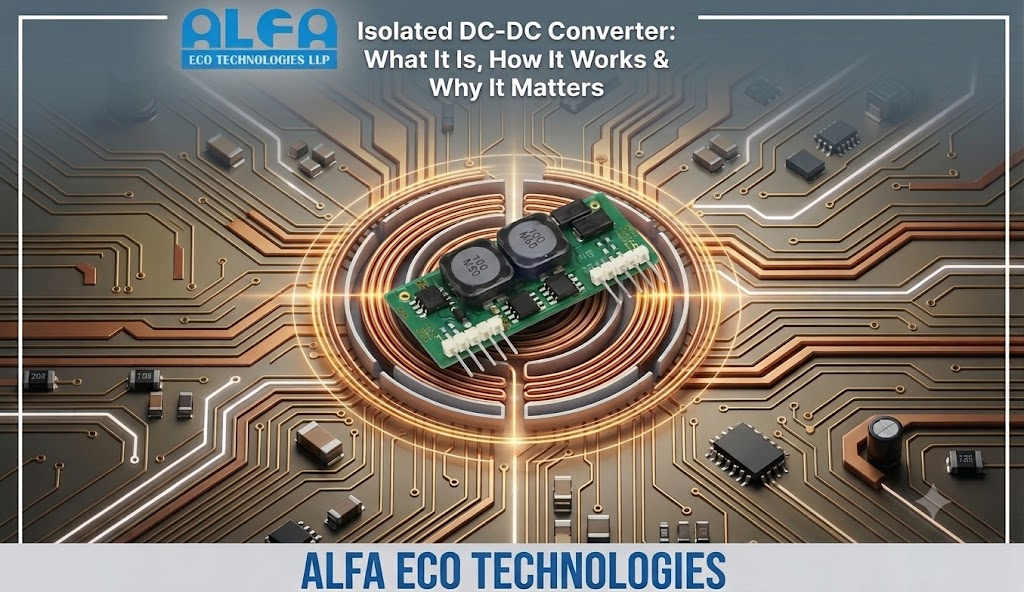
Isolated DC-DC Converter : What It Is, How It Works & Why It Matters
Modern electronic systems require stable and safe power conversion. One of the most reliable solutions used across industries is the Isolated DC-DC Converter. These converters are designed to transfer electrical power between circuits while keeping the input and output electrically separated.
What Is an Isolated DC-DC Converter ?
An isolated DC-DC converter is a power electronic device that converts direct current (DC) voltage from one level to another while providing electrical isolation between input and output circuits.
Electrical isolation means there is no direct electrical connection between the input power source and the output load. Instead, energy is transferred through magnetic components such as transformers or inductors.
Simple Definition
An Isolated DC-DC Converter :
- Converts DC voltage to another DC voltage
- Keeps input and output circuits electrically separated
- Protects systems from electrical noise and faults
This isolation improves safety, stability, and reliability, especially in sensitive electronic systems.
Why Isolation Is Important in Power Electronics ?
Isolation plays a critical role in protecting equipment and users from electrical hazards.
1. Electrical Safety
Isolation prevents dangerous high voltage from reaching low-voltage systems or user-accessible components.
2. Noise Reduction
Industrial systems and power electronics often generate electrical noise. Isolation prevents this noise from affecting sensitive circuits.
3. Ground Loop Protection
Isolated converters eliminate ground loop issues, which can cause instability or malfunction in electronic systems.
4. System Reliability
By separating circuits, isolated converters reduce the risk of damage from faults or voltage spikes.
How an Isolated DC-DC Converter Works
The operation of an isolated DC-DC converter typically involves several stages.
Step 1: DC Input
The converter receives DC voltage from a power source such as :
- Battery systems
- Power supply units
- Renewable energy systems
Step 2 : Switching Circuit
A switching circuit rapidly converts the DC input into high-frequency AC signals.
Step 3: Transformer Isolation
The AC signal passes through a high-frequency transformer that provides electrical isolation while transferring energy.
Step 4 : Rectification
The AC output from the transformer is converted back into DC using rectifier circuits.
Step 5 : Output Filtering
Filters smooth the output voltage to provide stable DC power to the load.
This process ensures efficient power transfer with safe electrical isolation.
Types of Isolated DC-DC Converters
Different converter topologies are used depending on power requirements and applications.
Flyback Converter
The flyback converter is one of the most common isolated DC-DC converters used in low-to-medium power applications.
Typical Uses :
- Consumer electronics
- Power adapters
- Industrial Equipment
Forward Converter
Forward converters transfer energy directly through the transformer during the switching cycle.
They are commonly used in :
- Telecommunications systems
- Industrial power supplies
- Computing equipment
Push-Pull Converter
Push-pull converters use two switching transistors and provide higher efficiency for medium power applications.
Common Uses Include :
- Automotive electronics
- Power inverters
- Industrial power systems
Full Bridge & Half Bridge Converters
These topologies are used in
high-power applications
where high efficiency and stable performance are required.Industries using these converters include :
- Electric vehicles
- Renewable energy systems
- Data centers
Key Applications of Isolated DC-DC Converters
Isolated converters are widely used across many industries because of their safety and reliability.
Electric Vehicles (EVs)
Electric vehicles use isolated converters to safely step down high-voltage battery power to lower voltages used by onboard electronics.
Renewable Energy Systems
Solar and wind power systems rely on isolated converters to regulate voltage and maintain safe energy transfer.
Industrial Automation
Factory equipment, robotics, and automation systems require isolated power supplies to prevent electrical interference.
Telecommunications
Telecom infrastructure and data centers use isolated converters to maintain stable power for networking equipment.
Medical Equipment
Medical devices require strict electrical isolation to ensure patient safety.
Key Features of High-Quality Isolated DC-DC Converters
When selecting an isolated DC-DC converter, engineers look for several important features :
- High conversion efficiency
- Wide input voltage range
- Strong electrical isolation
- Thermal protection systems
- Compact and lightweight design
- Reliable performance in harsh environments
These features ensure the converter operates safely and efficiently across demanding applications.
Benefits of Using Isolated DC-DC Converters
Improved Safety
Electrical isolation protects both equipment and users from dangerous voltage levels.
Reduced Electrical Noise
Isolation blocks electromagnetic interference and improves system performance.
Higher Reliability
Separated circuits reduce the risk of system failures caused by voltage spikes or grounding issues.
Flexible Power Design
Isolated converters support multiple voltage outputs and complex system architectures.
Choosing the Right Isolated DC-DC Converter
Selecting the right converter depends on several technical requirements.
Key factors include :
- Input voltage range
- Output voltage requirements
- Power rating
- Isolation voltage rating
- Efficiency level
- Environmental conditions
Choosing the right converter ensures long-term reliability and optimal system performance.
Future of Isolated DC-DC Converters
Power electronics technology continues to evolve rapidly. New innovations are improving the performance of isolated converters.
Emerging trends include :
- Silicon carbide (SiC) power devices
- Gallium nitride (GaN) switching technology
- Higher efficiency converters
- Compact high-density designs
- Smart power management systems
These advancements will play a major role in
electric vehicles, renewable energy, and next-generation electronics
.Frequently Asked Questions (FAQ)
Q1. What is an isolated DC-DC converter ?
An isolated DC-DC converter is a power converter that changes DC voltage levels while keeping the input and output electrically separated using a transformer.
Q2. Why is electrical isolation important in converters ?
Electrical isolation protects equipment from voltage spikes, reduces electrical noise, and improves overall system safety.
Q3. Where are isolated DC-DC converters used ?
They are widely used in electric vehicles, telecommunications, renewable energy systems, industrial automation, and medical devices.
Q4. What components provide isolation in these converters ?
Isolation is usually achieved using high-frequency transformers that transfer energy without direct electrical contact.
Q5. What is the difference between isolated and non-isolated converters ?
- Isolated converters provide electrical separation between input and output.
- Non-isolated converters do not provide isolation and directly connect the circuits
Final Thoughts
An isolated DC-DC converter is a critical component in modern power electronics. It ensures safe, reliable, and efficient voltage conversion across many industries.
From electric vehicles to industrial automation and renewable energy systems, isolated converters provide the electrical safety, stability, and performance required for advanced electronic systems.